The Fibromyalgia Supplement Graveyard: What We Wish We'd Known Before Spending Thousands
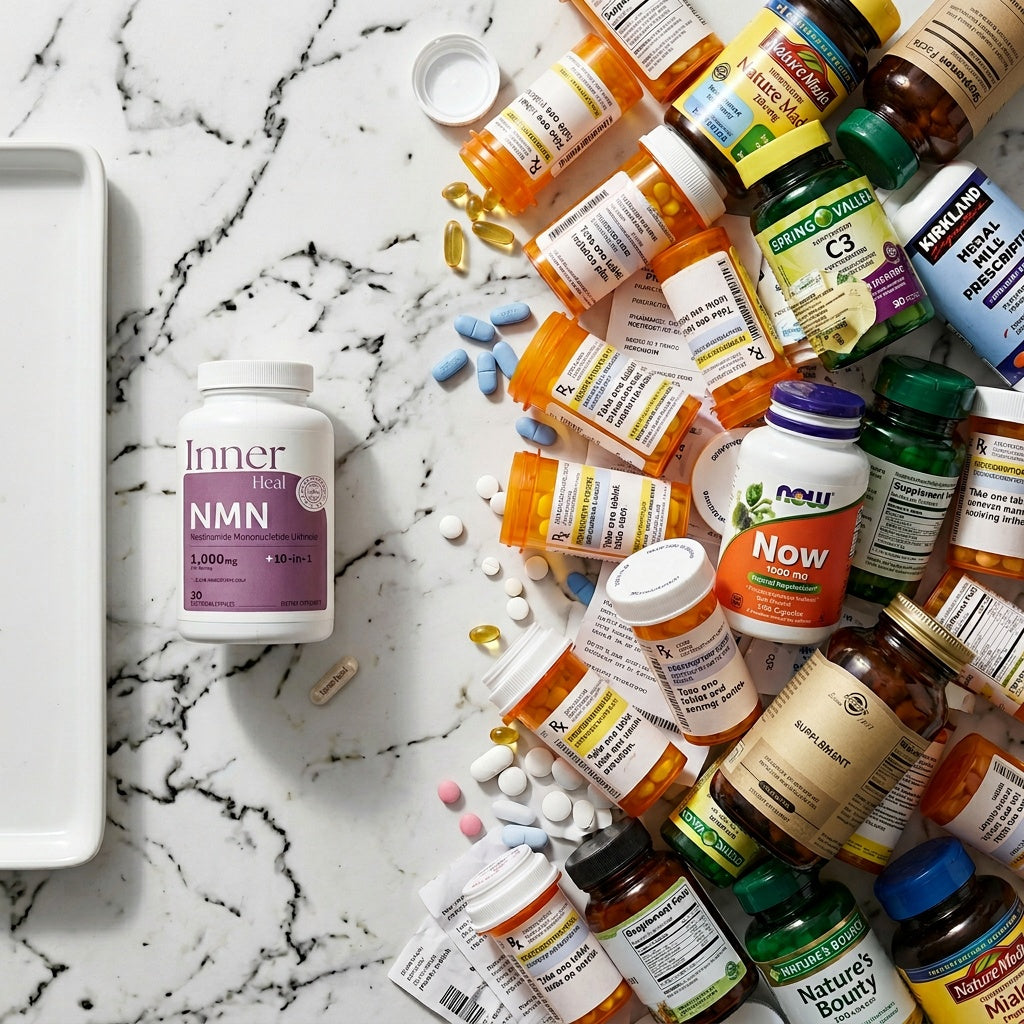
The Supplement Graveyard
An honest look at what most of us have tried, why each one tends to leave us still tired, and what current cellular research suggests about multi-pathway support.
If you have fibromyalgia, there's a drawer in your house we already know about. The one with the half-empty bottles of magnesium, turmeric, CoQ10, ashwagandha, B12, CBD oil, and whatever was trending on TikTok eighteen months ago. We have that drawer too. And we want to talk honestly about why none of it has been enough on its own.
Let's name it. Fibro women have what we've started calling the supplement graveyard — and most of us are sitting on $2,000, $4,000, sometimes more in bottles that each promised to be a meaningful piece of the puzzle, and each turned out to be one piece of a much bigger picture.
This isn't an article about how supplements are scams. They're not. Most of them do exactly what their research supports them to do. The challenge for women with fibromyalgia is that the picture researchers are uncovering looks multi-systemic — meaning single-ingredient supplements, individually, often address single pieces of what may be a much larger story.
So here's the honest accounting. What's in the graveyard, what each one does well, what each one doesn't do, and what current cellular research suggests about the broader picture.
What's your graveyard actually costing you?
Tap every bottle you currently take. Watch the monthly total climb.
Why the graveyard exists in the first place
Before we dig into specific supplements, we want to acknowledge something. The reason the graveyard exists isn't because we're gullible. It's because we're resourceful, and we've been left to research this on our own.
Most fibro women have been through some version of this: diagnosis (often after years of being dismissed), a prescription for Lyrica or Cymbalta or gabapentin (which helps with one thing but creates new challenges with another), and then a quiet handoff from the medical system back to ourselves. "We don't fully understand what causes this. There's no cure. Here's some advice about sleep hygiene and exercise."
So we go online. We join Facebook groups. We read Reddit threads. We watch TikToks. And we see another fibro woman saying this one helped me, and hope shows up again, and we click "add to cart." It's not gullibility. It's biology trying to find a way through.
The graveyard isn't proof we made bad decisions. It's proof we kept trying, even when the system stopped trying for us.
With that on the table, let's talk about what's actually in there — and rate each one honestly on what it does well and what it doesn't address.
The graveyard, scored honestly
Magnesium Most common
Supports muscle relaxation. Supports a calm nervous system. Can help with sleep onset for some people. A real mineral with real research behind it.
Doesn't support NAD+ levels. Doesn't engage with the cellular pathways current fibromyalgia research is exploring. Addresses one piece — not the broader cellular picture.
Turmeric / Curcumin Anti-inflammatory
Has research behind its effect on certain inflammatory markers. Legitimate compound — especially when paired with black pepper extract for absorption.
Doesn't support NAD+ production. Doesn't directly engage with the mitochondrial pathways researchers are studying in chronic conditions.
CoQ10 Most fibro-researched
Supports the electron transport chain inside mitochondria. Research has repeatedly found lower CoQ10 in fibromyalgia populations. We kept this in our formula for a reason.
Supports one step of mitochondrial energy production. Doesn't support NAD+ levels or other pathways researchers are examining alongside it. Important — but typically part of a bigger picture.
Ashwagandha TikTok darling
Has research behind its effect on the stress response and cortisol regulation. Can reduce subjective anxiety for many people.
Targets the stress response pathway, not cellular energy production. Research suggests fibromyalgia involves more than the stress response alone — so adaptogens, however helpful for stress, may not address other factors researchers are exploring.
Vitamin B12 Energy claim
Essential for energy metabolism, methylation, and nerve function. If you're actually deficient, supplementing it can help significantly.
If you're not deficient, B12 alone doesn't address the broader cellular questions researchers are studying. B12 is a substrate that other cellular processes rely on — it doesn't directly support NAD+ or sirtuin pathways.
CBD oil Pain-focused
Modulates pain signaling through the endocannabinoid system. A 2024 UK study of nearly 500 fibromyalgia patients on a medical cannabis registry reported the greatest improvements at higher daily CBD doses.
Research on CBD's effect on cellular energy and NAD+ is essentially absent. If you bought CBD hoping it would address the fatigue, the research suggests it's a tool for a different problem.
"Energy" blends + other adaptogens The rest of the drawer
Each addresses one specific pathway — neurotransmitter precursors, methylation, focus, alertness. Many have research behind their individual claims.
Most don't engage with the cellular pathways current fibromyalgia research is exploring. They tend to be surface-level interventions for a picture researchers are increasingly describing as multi-systemic.
The pattern hiding in the drawer
Look at what we just walked through. Every single supplement in the graveyard tends to target one of the following:
- One symptom (pain, sleep onset, anxiety, focus)
- One pathway (nervous system, electron transport chain, stress response, serotonin precursors)
- One specific deficiency (B12, magnesium, CoQ10)
None of them, individually, addresses the full set of pathways current cellular research is exploring. And fibromyalgia research increasingly describes the condition as multi-systemic — involving multiple cellular and neurological systems researchers are still working to map.
Researchers exploring fibromyalgia are looking at multiple cellular pathways. Here's what different approaches actually cover.
(e.g. Magnesium)
(Inner Heal)
Single supplements aren't bad. They just don't address the full set of pathways researchers are currently exploring.
This isn't an argument against single supplements. It's an argument against expecting any single supplement to map onto a research picture that's increasingly multi-pathway. Magnesium is great for what it does. CoQ10 has real fibromyalgia research behind it. Turmeric has its place. They're just not, on their own, designed to cover the breadth of what current cellular research is examining.
What the research suggests a multi-pathway approach looks like
The peer-reviewed literature on cellular dysfunction in fibromyalgia is still being written. But the pathways researchers continue to point to converge in a consistent direction:
- NAD+ support. NMN (nicotinamide mononucleotide) is the most-studied precursor. A 2024 Scientific Reports study documented bioenergetic differences in fibromyalgia patients, and the literature on NMN's effect on blood NAD+ levels in humans is now extensive.
- CD38-related compounds. Quercetin and apigenin are being studied for their interaction with CD38 — an enzyme researchers are increasingly examining in chronic inflammatory states.
- Mitochondrial cofactors. CoQ10 supports the electron transport chain. This is one of the longest-running areas of fibromyalgia-specific supplement research.
- Methylation support. NMN consumes methyl groups in the body's NAD+ cycle. TMG (trimethylglycine) supports methylation, which becomes relevant with sustained NMN supplementation. It's also of interest to women with MTHFR variants.
- Antioxidant defense. Glutathione, astaxanthin, and resveratrol support cellular defenses against the oxidative stress researchers have repeatedly documented in fibromyalgia patients. The 2025 Frontiers review specifically named elevated MDA and 4-HNE markers as features they continue to find.
- Sirtuin support. Resveratrol activates SIRT1, one of a family of cellular maintenance enzymes that depend on NAD+.
Six pathways. Ten ingredients, when you formulate carefully. This is the part most NMN brands don't address — they sell NMN alone, or NMN plus resveratrol, and their customers wonder why nothing meaningful changes after three months.
This is also the reasoning behind why we built our 10-ingredient formula the way we did. We didn't set out to start a supplement company. We set out to consolidate a graveyard, because women who've already tried everything don't need more bottles — we need one that aligns with the multi-pathway research direction. Ten ingredients in one formula at meaningful doses, costing $39.99/month, with third-party purity testing — designed to align with what cellular research is currently exploring.
How to read a supplement label honestly
Five questions to ask before you add another bottle to the drawer.
According to ConsumerLab, independent testing has repeatedly found significant variation between what supplement labels claim and what bottles actually contain. This is especially true for NMN. If a brand won't show you a Certificate of Analysis, that tells you something important.
What we wish someone had told us in year one
If you're at the beginning of your fibromyalgia journey — newly diagnosed, drowning in advice, just starting to build the graveyard — please save yourself the years we spent figuring this out. The reason single-ingredient supplements often disappoint isn't that they don't do what they claim. It's that the cellular picture researchers are uncovering looks broader than any single ingredient is designed to cover.
And if you're like us — ten or fifteen years in, a drawer full of bottles you've stopped throwing away because you keep thinking maybe you should give one another try — the graveyard isn't a sign of failure. It's a record of how hard you've been trying to take care of yourself in a system that didn't give you the tools we needed.
You weren't asking the wrong question. You were given partial answers. The cellular picture researchers are now mapping is the one we needed all along.
One bottle. Ten ingredients. The pathways research is exploring.
Inner Heal NMN was built for women with fibromyalgia who are done assembling single-ingredient routines that cover one pathway at a time. Third-party purity tested. 100-day money-back guarantee. Replaces $150+ in separate bottles.
See what's inside →This article is for educational and informational purposes only and is not medical advice. It does not constitute a diagnosis or treatment recommendation. Inner Heal is a dietary supplement, not a treatment for fibromyalgia or any other medical condition. Statements about ingredients have not been evaluated for the treatment of any disease. The cause of fibromyalgia is officially unknown. References to ingredient research describe what scientists are currently studying — not confirmed mechanisms or treatments for any specific condition. Always consult your healthcare provider before starting any new supplement, especially if you are taking prescription medications or managing a chronic condition. Individual results vary.