Why Am I So Tired With Fibromyalgia? The 2024 Mitochondrial Discovery No One's Talking About
Why Am I So Tired With Fibromyalgia?
The mitochondrial research no one's talking about — and what it finally proves about the exhaustion we've been describing for years.
If you have fibromyalgia and you've ever caught yourself typing "why am I so tired" into Google at 3pm — exhausted, frustrated, wondering if anyone has a real answer — this is for you. Because in 2024, researchers finally measured what we've been feeling for years. And what they found changes everything.
We need to start with something most fibromyalgia content gets wrong.
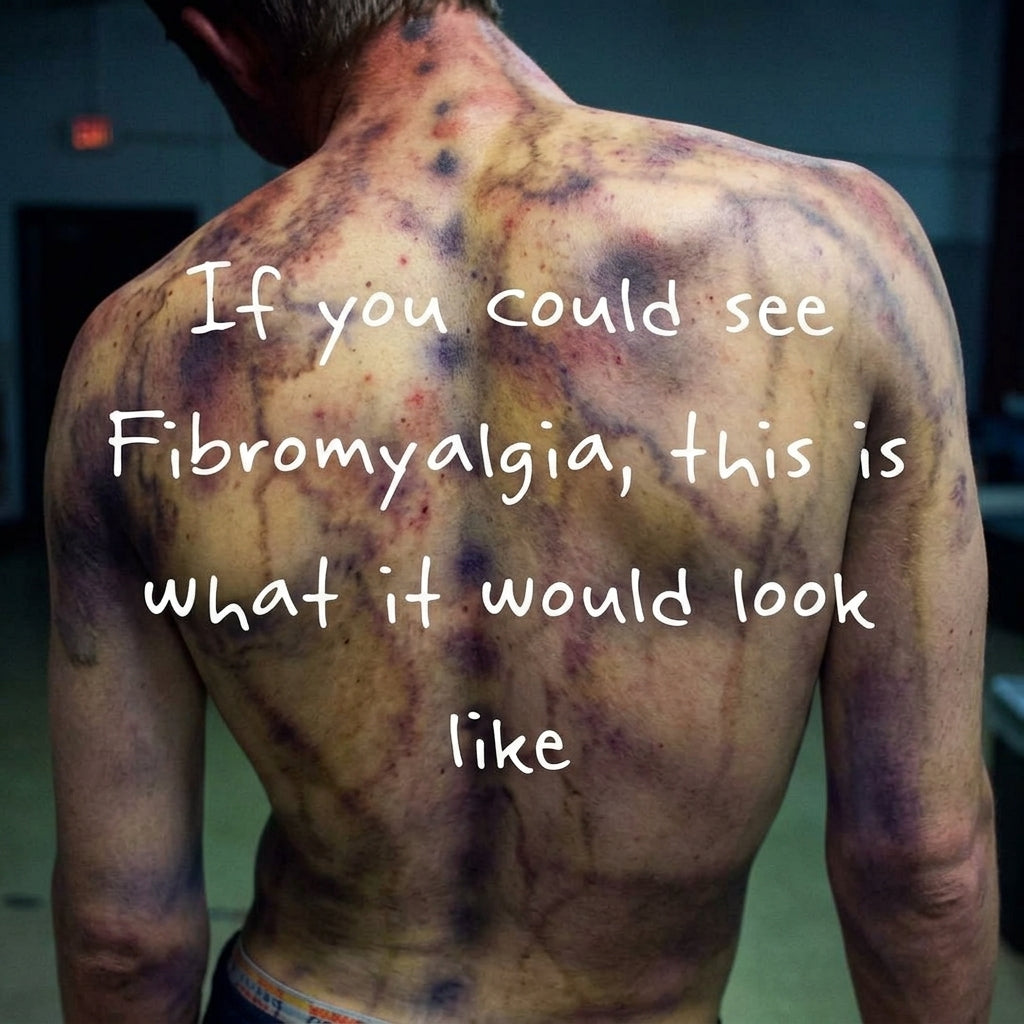
Fibromyalgia fatigue isn't tiredness. It isn't "you should exercise more" tiredness, it isn't "you need to manage your stress better" tiredness, and it definitely isn't "have you tried going to bed earlier" tiredness. It's a profound, heavy, full-body depletion that doesn't lift after sleep, doesn't respond to caffeine the way it used to, and makes the simplest tasks — putting away groceries, replying to a text, deciding what to make for dinner — feel like climbing a mountain in lead boots.
If you have fibromyalgia, you already know this. You've lived it. You've also probably had the experience of trying to describe it to a doctor or a family member and watching their eyes glaze over. Because "tired" is a word everyone thinks they understand — and almost no one understands what we mean by it.
Here's the part that matters: for decades, this exhaustion was treated as a symptom without a measurable cause. Bloodwork came back normal. Scans came back normal. So the message — sometimes spoken, sometimes implied — was that maybe it was in our heads. Maybe we were just stressed. Maybe we needed to push through.
That story is now over. Because in late 2024, a research team published something in Scientific Reports (a Nature journal) that should be on every fibromyalgia clinic's reading list — and somehow still isn't on most fibro blogs. They measured mitochondrial function in 50 women with fibromyalgia and compared it to 20 healthy controls. And what they found wasn't ambiguous.
The 2024 study that finally proved what we've been feeling
The researchers measured something called the Bioenergetic Health Index (BHI) — a composite score that captures how well a cell's mitochondria are actually producing energy. Mitochondria, if you haven't run into the term recently, are the tiny structures inside every one of your cells that generate ATP, which is the molecule your body uses for fuel. Brain function, muscle contraction, hormone production, immune response, hair growth, skin renewal, digestion — all of it runs on ATP. And ATP is made by mitochondria.
Here's what they found in fibromyalgia patients compared to healthy controls:
- A 22% lower bioenergetic health index — meaning mitochondria producing meaningfully less usable energy
- Elevated mitochondrial superoxide (oxidative stress) inside cells
- Lower mitochondrial membrane potential — a sign mitochondria are struggling to function
- And critically: the severity of the mitochondrial dysfunction correlated with the severity of symptoms. The worse the cells were doing, the worse the fibromyalgia.
Read that last line again. The fatigue isn't disconnected from a measurable biological problem. It is the measurable biological problem.
Why this matters in plain language: If your mitochondria are producing 22% less energy than a healthy person's mitochondria, you would experience exactly what we experience. Bone-deep fatigue. Pain that flares when you push past your limit. Brain fog that lifts only when you rest for hours. Recovery times measured in days instead of hours. None of this is in your head. It's in your cells.
And it isn't just one study. A 2025 scoping review in Frontiers in Pain Research pulled together the evidence from across the entire field and reached the same conclusion: fibromyalgia involves mitochondrial dysfunction, elevated oxidative stress markers (MDA, 4-HNE), and impaired antioxidant defenses including reduced CoQ10. Earlier work in muscle tissue using magnetic resonance spectroscopy found significantly lower ATP and phosphocreatine in the muscles of fibro patients — the literal fuel reserves were running on empty.
So now the question becomes: why are our mitochondria struggling? What's actually draining the fuel? And — more importantly — is there anything we can do about it?
The inflammation loop nobody's testing for
To answer that, we need to introduce one more piece of biology. Don't worry — we'll keep it human.
Inside every cell, mitochondria depend on a molecule called NAD+ to produce energy. Think of NAD+ as the spark plug — without it, the engine doesn't fire. NAD+ also activates the enzymes that resolve inflammation and repair damaged DNA. It's one of the most important molecules in cellular biology, and your body makes it constantly.
Here's the problem. There's an enzyme called CD38 that destroys NAD+. CD38 isn't supposed to be a problem — it has legitimate jobs in the immune system. But chronic inflammation ramps CD38 production way up, and ramped-up CD38 starts shredding NAD+ at a rate the body can't keep up with.
And here's the cruel part: NAD+ is also what your body uses to resolve inflammation. So you end up in a self-reinforcing loop.
A self-reinforcing cycle. The fire is burning, and the molecule that's supposed to put it out is being destroyed faster than the body can replace it.
This is the loop we've started calling the inflammation loop — and it's the mechanism that explains why fibromyalgia feels the way it feels. The fire is burning, and the molecule your fire department needs to put it out is being destroyed faster than your body can replace it.
The fatigue we feel isn't laziness. It isn't depression. It isn't "just aging." It's a measurable biological mechanism that researchers are finally documenting — and it's been happening inside our cells the whole time.
Why sleep alone won't fix this
One of the most painful things about fibromyalgia fatigue is that sleep doesn't restore us the way it restores other people. We can sleep nine hours and wake up feeling like we slept three. We can nap for two hours in the afternoon and feel worse afterward, not better.
This isn't a discipline problem. This is what happens when mitochondria are dysfunctional and NAD+ is depleted: your cells can't fully recharge no matter how long you rest. Sleep is when the body normally restores cellular energy reserves. But if the machinery that makes the energy is broken, sleep can't compensate.
The analogy that finally made it click for us: It's the difference between an empty battery and a damaged battery. An empty battery just needs to be plugged in. A damaged battery doesn't hold the charge no matter how long you leave it on the charger. Fibromyalgia is the second one.
This is also why the standard advice — sleep hygiene, melatonin, magnesium, no screens after 9pm — helps a little but never quite gets us to where healthy people are. Those interventions improve the sleep environment. They don't repair the cellular machinery. We've gone deep on this in our piece on sleeping through the night with fibromyalgia if you want the full breakdown.
What about the medications? The supplements? Why haven't they worked?
Here's where a lot of fibro women feel a flash of anger, and rightly so. We've spent years — sometimes decades — taking medications that addressed pain signaling, or sleep onset, or mood. We've spent thousands on supplements that addressed individual deficiencies. And almost none of it has touched the fatigue.
Now we know why.
What most treatments target
- Pain signaling (Lyrica, gabapentin)
- Mood / sleep onset (Cymbalta, melatonin)
- One vitamin deficiency (B12, magnesium)
- One inflammatory pathway (turmeric)
- One adrenal response (ashwagandha)
What the loop actually needs
- NAD+ replenishment (NMN)
- CD38 inhibition (quercetin + apigenin)
- Mitochondrial fuel (CoQ10)
- Methylation support (TMG)
- Antioxidant defense (glutathione, astaxanthin, resveratrol)
Pregabalin, gabapentin, duloxetine — these target how the nervous system processes pain. They don't touch mitochondrial function. They never could.
Magnesium helps with muscle tension and sleep onset. It doesn't restore NAD+. CoQ10 supports the electron transport chain, which is genuinely helpful for fibro patients (research has consistently shown CoQ10 deficiency in this population) — but it's one piece of a much larger puzzle. Turmeric reduces inflammation; it doesn't repair the cellular damage inflammation has already caused. Magnesium, turmeric, CoQ10, B12, ashwagandha — none of these, on their own, can break the CD38/NAD+ loop. They each address one symptom or one pathway. The loop has multiple pathways.
If you've built up what we call the supplement graveyard — a drawer full of bottles that each promised to be the answer and each turned out to be a partial fix at best — there's a reason. None of them were designed to address the actual mechanism. We wrote a longer piece about what we wish we'd known before spending thousands on fibro supplements if that resonates.
What cellular support actually looks like
If the problem is the CD38/NAD+ loop, then breaking the loop requires doing two things at once:
- Replenish NAD+. The most direct way to do this is with NMN (nicotinamide mononucleotide), a precursor your body converts directly into NAD+. NMN has been studied in multiple clinical trials, and a 2024 meta-analysis confirmed that NMN supplementation significantly elevates blood NAD+ levels across 12 studies and 513 participants. Refilling the tank.
- Slow down CD38. Two natural compounds — quercetin and apigenin — have both been shown to inhibit CD38 activity. This is the part most NMN supplements don't address. Refilling the tank while a hole is still draining it isn't enough. You have to plug the hole, too.
You also need mitochondrial cofactors (CoQ10 for the electron transport chain), methylation support (TMG, because long-term NMN supplementation depletes methyl groups), and antioxidant protection (glutathione, astaxanthin, resveratrol) to defend the cellular machinery while it's being repaired.
This is why a single-ingredient NMN supplement, taken on its own, often disappoints fibro women who try it. It addresses one pathway. The CD38/NAD+ loop spans multiple pathways. That's also the reasoning behind the 10-ingredient formula we built when we couldn't find anything on the market that targeted the full loop — but we'll come back to that in a moment.
How long does it take to feel a difference?
We want to be honest about timelines because too many supplement brands aren't, and fibro women have earned the right to be skeptical of anyone who promises overnight transformation.
This is cellular repair, not a stimulant. Caffeine works in 20 minutes because it borrows energy you don't have. NMN works over weeks and months because it actually rebuilds the system that produces energy. The trade-off is patience for sustainability.
Quick caveat: we want to be clear that no supplement is approved to treat fibromyalgia, and we'd never claim Inner Heal is. What we're describing is cellular support — restoring molecules your body makes less of after 30 and 40, that fibromyalgia depletes further. The underlying mechanism (CD38/NAD+ depletion in chronic inflammatory conditions) has been documented in multiple peer-reviewed studies. The fibro-specific clinical trial on this exact formula doesn't yet exist. We say that up front because we'd want someone to tell us.
What we wish someone had told us 10 years ago
The single hardest part of having fibromyalgia isn't the fatigue, or the pain, or even the sleep. It's the years of being told there's nothing measurably wrong — when something measurably wrong is happening inside our cells every minute of every day.
The 2024 research validates what we've been describing. The 2025 review consolidates it. The science is moving fast now, and the consumer story hasn't caught up yet.
If you take one thing from this piece
- Your fatigue is real, measurable, and has a biological mechanism
- You are not lazy. You are not broken. You are not imagining it.
- Your cells are running on empty in a way that science can now document
- "Normal bloodwork" isn't proof nothing is wrong — it's proof the panel didn't measure cellular function
- Cellular support is multi-pathway by necessity. Single supplements can't break a multi-pathway loop.
Most NMN brands are still talking about "anti-aging" and "longevity" — generic wellness language aimed at a demographic that has never experienced what we've experienced. The fibromyalgia community has been left out of a category that was practically designed for us. We built Inner Heal because we couldn't find a formula that took our experience seriously. If that's what you've been looking for, the door is open.
Built for the women the longevity industry forgot
Inner Heal NMN combines 500mg NMN with 9 supporting ingredients that target the CD38/NAD+ inflammation loop together — not one pathway, six. Third-party purity tested. 100-day money-back guarantee.
See the formula →This article is for educational purposes and is not medical advice. Inner Heal is a dietary supplement, not a treatment for fibromyalgia or any other disease. Always consult your healthcare provider before starting a new supplement, especially if you're taking prescription medications. Individual results vary.